



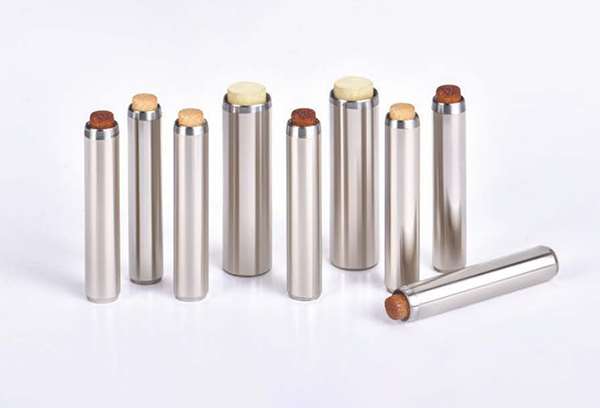
Recently, with the improvement of precision and stability requirements in the mold manufacturing industry such as stamping and die-cutting, the solid rubber elastic hole series (sleeve structure, special for screws) as the core elastic component has attracted widespread attention from the industry. In addition to the hardness parameters that are usually concerned, multiple factors such as size adaptation, material characteristics, and working condition adaptation directly affect the operating efficiency and service life of the mold, which has become a key link in the selection process.
Dimensional adaptation: lay the foundation for installation and operation
The size matching of solid rubber elastic holes is the primary prerequisite for selection. The inner diameter should form a reasonable gap with the matching screws, usually about 0.2mm larger than the diameter of the screw rod (such as M4 screws adapted to φ4.2 inner diameter) to avoid installation lag or operation offset; The combination of the outer diameter and the mounting hole of the formwork should be controlled in the range of micro clearance or light tightness, which is easy to lead to skew during work, and too tight will increase the difficulty of installation and may cause component extrusion cracking. According to the industry common standard, the dimensional tolerance is controlled within the range of ±0.1mm, which can effectively ensure interchangeability and adaptation stability, which is consistent with the specification logic of the mating gap in "O-shaped rubber sealing ring for pneumatics - groove size and tolerance" (JB/T 6658-2007).
Height vs. compression: balance elasticity with service life
The scientific matching of free height and compression directly affects elastic properties and durability. Industry practice shows that the compression amount should be controlled within the appropriate range of 15%~25%, and the maximum should not exceed 30%, otherwise it is easy to cause permanent deformation or bursting of parts. Its height calculation should be combined with the mold defeeding stroke, usually according to the formula of "required glue height≈ deloading stroke ÷ (0.15~0.25)", which not only ensures sufficient elastic output, but also reserves a safe stroke. For example, the free height of the elastic hole corresponding to the 10mm stripping stroke is recommended to be between 40~67mm, and the standard size can be selected according to the actual installation space.
Material selection: adapt to the needs of different working conditions
At present, the mainstream materials in the market are polyurethane (PU, commonly known as Uni rubber) and ordinary rubber (NR/SBR). Polyurethane material has become a common choice in the mold industry due to its wear-resistant and rebound stability characteristics, especially suitable for conventional stamping and die-cutting working conditions. ordinary rubber is suitable for low-frequency and low-load scenarios by virtue of its cost advantages and low-temperature resistance. In special environments, the choice of materials needs to be further refined: for heat-generating conditions such as high-speed continuous molds, it is recommended to choose PU materials with good heat resistance; In oily environments, oil-resistant PU can effectively avoid swelling and deformation, which is in line with the specification requirements of the "Technical Conditions for Polyurethane Foam Moulds" (JB/T 11663-2013) on material adaptation conditions.
Adaptation to working conditions: taking into account the environmental and structural requirements
The use environment and mold structure have an important impact on the selection. In terms of operating temperature, conventional materials can be selected under normal temperature conditions, and heat-resistant materials should be given priority in medium and high temperature environments (such as above 80°C) to avoid elastic attenuation. In terms of installation structure, the elastic hole is easy to form a vacuum when compressed, so the bottom of the formwork needs to reserve φ2~φ3mm ventilation holes, or choose products with its own breathable structure to ensure smooth rebound. In the force arrangement, it is necessary to follow the principle of uniform symmetry, and the stress concentration areas near large punching holes, bending positions and other stress concentration positions can be appropriately encrypted and arranged, and at the same time avoid key parts such as blanking holes and guide column holes to prevent interference.
Service life: Combine frequency with maintenance needs
The service life of the product is closely related to hardness, material, and frequency of use. Generally speaking, products with higher hardness have better wear resistance and compressive resistance (e.g., 90° hardness products are suitable for heavy-duty limit scenarios), but the impact on the product surface needs to be balanced. For molds that run frequently (such as tens of thousands of times a day), it is recommended to use high-wear-resistant PU materials to reduce the frequency of replacement; For scenarios with high surface protection requirements, such as exterior parts processing, products with a hardness of 35°~55° can be given priority to ensure the use effect through regular replacement.
Industry experts said that the selection of solid rubber elastic hole series needs to be based on a comprehensive evaluation of mold working conditions, product requirements, and installation conditions, and follow the principle of "size adaptation, working condition matching, and performance balance" in order to give full play to its core role in stripping, buffering, and resetting. With the advancement of the standardization process of the mold industry, scientific selection according to relevant industry standards will become a key measure to improve the stability and production efficiency of mold operation.
 Service Hotline:138-0226-6823